

Tap tap...is this thing on?
So. I've been gone from this blog. And you know why? I've been cheating on my fiction with another genre.
Friday, October 31, 2014

Sunday, July 07, 2013
Sunday Review: COOKED, by Michael Pollan
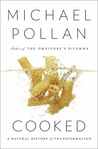 Cooked: A Natural History of Transformation by Michael Pollan
My rating: 4 of 5 stars
"Yet there is a deeper kind of learning that can only be had by doing the work yourself, acquainting all your senses with the ins and outs and how-tos and wherefores of an intricate making. What you end up with is a first-person, physical kind of knowledge that is the precise opposite of abstract or academic. I think of it as embodied knowledge, as when you nose or your fingertips can tell you that the dough needs another turn or is ready to be baked....Eating and drinking especially implicate us in the natural world in ways that the industrial economy, with its long and illegible supply chains, would have us forget....To make it [beer] once in a while, to handle the barley and inhale the aroma of hops and yeast, becomes, among other things, a form of observance, a weekend ritual of remembrance."
One review I read of this book claims this is simply a repeat of everything Pollan has written before. I find that to be a complete misunderstanding of this book. If anything, I find this book to be unlike his other food books, and rather more similar to A Place of My Own: The Education of an Amateur Builder in its almost spiritual approach to the subject at hand, and in Pollan's positioning himself as not the expert researcher, but the novice. Yes, some of Pollan's central theses remain: whole foods are good, industrialization of food has had terrible consequences on our health, but this takes it to a different level. This is less about the individual act of eating than the communal act of creating.
Although Pollan's other books contain anecdotes of his visits to various people and places to understand his topic, this book is more his grappling with what he learns and trying to apply it immediately. (Again why it reminds me more of APOMO rather than his other food books—he's again "building," just this time with food.) Yes, there's a good bit of information about the evolution of all these different kinds of cooking, but a lot of the focus is simply on Pollan's own transformations in his understanding of not only the processes of cooking, but their significance to him personally.
Where his other books are outward, I would describe this book as inward. Yes, it contains some scathing criticisms of industrial food culture (it doesn't stray from the theses in Omnivore's)And approaching it that way, I found it the most satisfying of all his food books to read. It's a book that will get you to think about why it's necessary to cook; not from a "this is good for your health" or "processed food is evil" standpoint, but from the idea that the act of cooking and sharing food is good for the soul.
I see this book as being the parallel to The Omnivore's Dilemma--4 foods, and now 4 preparations. The outward exploration of the purpose of food, and then the inward contemplation of preparing and consuming it. I look forward to it coming out in paperback, because I think the two books together will make a nice paired gift to my foodie friends (well, the ones who haven't already devoured everything Pollan has to offer.)
View all my Goodreads reviews
Wednesday, July 03, 2013
How I Learned to Stop Worrying and Love "the Rules"
 |
| (CC-BY-NC-ND) by tamaki |
My brothers played the violin, learning via the Suzuki method, which is a method that teaches young children to play using the same principles of language learning—first you listen, then you imitate, then, when you are already proficient at producing speech (or music in this case) you learn to read.
When I was four or so, I started dancing to my brothers' "listening tapes," the music they were learning to play. My mother, instead of taking this as a sign to get me dance lessons (which was what I wanted), decided to get me piano lessons instead.
Now, in the grand, grand scheme of things, I don't play piano very well. I took lessons for seven years, until just after I turned eleven. One thing I remember most about piano lessons is how unbelievably tedious they were—having to learn to put my fingers in exactly the right order, practicing scales. I remember my teacher telling me things like "this needs to be even" or telling me to bend my wrist more. Her rigid insistence that it wasn't enough just to get all the notes right, I also had to bother with the mezzo pianos and the mezzo fortes (there's a difference?) and that even though fortissimo was a super fun volume, the keys still had to be struck just so.
And every day I had to practice for at least a half an hour. Crazy.

Tuesday, June 25, 2013
Shitty Scrivener First Drafts

The piece of her her advice I've always found difficult to put into practice, however, is the bit about creating the SFD: the shitty first draft. The ability to allow yourself, as a writer, to produce crap the first time around, so that you don't scare yourself out of putting something down on the page. I always think about it, and sometimes, I do better than others (NaNoWriMo comes to mind), but usually, I tend to get in my own way because the truth is I do produce better writing with relatively minimal attention to it. But it also means sometimes I get stuck, waiting for the next thing to move me forward.
However, after NaNoWriMo 2011 (and after they produced the Windows version), I bought Scrivener. At first, I just used it for revision, and preferred to produce my writing within Microsoft Word. But now I've transitioned almost completely to using it as my drafting tool.
And it's had a really unexpected effect: I feel a lot freer to make a mess.
Scrivener gives you the ability to work scene by scene, and to drag and drop those scenes into any organization you want. Currently, my method is to use the Blake Snyder beat sheet for drafting, and to organize my scenes into their beats, and then to go back and reorganize them into chapters.
Somehow, being able to drag and drop a scene anywhere has freed something up in my brain. Since it's not necessarily going to stay where I put it, I feel freer to write something that might not make sense right there. Or to jump to a scene I'm itching to write without writing the bridge (although I try to get to the bridge in the next writing session, lest I build up a writing project in which all the fun scenes are written and I end up with only the hard parts). I know that it's as easy as dragging the scene to "trash" to remove it, or back from trash to reinstate it, and somehow, that makes it much easier to write.
Additionally, I know I can tag the status of a scene. Scrivener's basic statuses are "to do" "first draft" "revision" and "final draft," but like all things in the program, they can be infinitely customized. So I have some statuses like, "WTF was I thinking?" or "Really great" to clue me in as to how much revision a particular scene is going to take and/or how happy I am with it (because happiness may simply be a factor of it being in the wrong place in the book, which is easily fixed!)
I find I'm drafting faster, revising harder, and that all of it is a lot more fun. I wouldn't have thought that I would adapt to a program--I'm a techie, if you can't tell, and so I usually find ways to make programs adapt to me--but Scrivener has finally brought me around to having the freedom that I first read in Anne Lamott's book almost twenty years ago.
I'm glad to have found it.
Do you use Scrivener or another noveling program? How do you like it?
And just for bonus kicks: here's my Scrivener template for the Blake Snyder Beat Sheet. Feel free to use it and share!
Tuesday, June 18, 2013
5 Great Books for a Graduate
One of the best parts about bookselling is handselling, which is when someone comes in looking not for a specific book, but a good book for a category: "For my thirteen-year-old nephew," or "for my friend's twin girls who are turning 2" (both were handsells yesterday). It's fun because it's when you get to put all your great reader skills to work as a bookseller—what's good in this genre? What follows well on other things that person has liked? What are the obscure, but cool books that the person otherwise might not pick up?
This time of year, I'm doing a lot of handselling of graduation gifts. It may be a little late for some, but in the interest of helping folks who may have a graduation party or two coming up, I thought I'd talk about my five favorite graduation books (and no, none of them are OH THE PLACES YOU'LL GO).
 1. HOW TO COOK EVERYTHING, THE BASICS by Mark Bittman. I'd been reading a home blog all through my undergrad years, and so when I graduated, I wanted the original HTCE (we won't mention how many years that's been out, just in case). HTCE and HTCE: Vegetarian are veritable encyclopedias of cooking knowledge and recipes. For a long time, the full HTCE was my go-to graduation gift. But in the last two years, Bittman published HTCE: The Basics, which makes an even sharper gift for someone just venturing away from Mom and/or the college cafeteria. It explains all the basic techniques of cooking, and gives a number of easy, healthful recipes to try, and it has photos and fewer pages, which make it a much less intimidating tome than the full HTCE.
 2. NICE GIRLS DON'T GET THE CORNER OFFICE, by Lois Frankel. This book should be handed out along with diplomas to every woman entering the workforce, in my opinion. While lately LEAN IN has been all the rage, this one is much more tactical. It's full of small things that girls are socialized to do differently than boys that hinder them in their careers—everything from asking permission for things to leaving trailing voicemails. I first listened to this book on tape eight years ago, and I still often turn to it when I'm on a long drive and see something new.
 3. THE MONEY BOOK FOR THE YOUNG, FABULOUS, AND BROKE, by Suze Orman. When I handsold this to a couple, the man in the couple described Orman as "smarmy," and I suppose he's right. At the same time, this is the best finance book for people in their teens and twenties, particularly those who are graduating into the recession. Advice to save money by just not going to Starbucks or eating out as often doesn't work when the person is too broke to go to Starbucks in the first place. This book addresses *that* reality, and takes people from good debt management to financial planning for home purchases and the like and everything in between.
 4. 36 Hours series, from the New York Times. These books, which compile itineraries from the Gray Lady's weekly travel column, provide a bunch of suggestions for great weekend getaways for most of the major regions of the United States (and one book is of Europe). If the grad is headed to a new city for her job, these can be the perfect reminder that R&R should go along with all that hard work.
 5. A great (recent) novel. Across the board, most students haven't done much reading lately that wasn't for school, and it can be an awesome gift to be given a new novel to read. I like to pick recent ones (and paperbacks, because they're cheap!), as it's unlikely the graduate will have read them; some of my picks this summer are WORLD WAR Z, BRINGING UP THE BODIES, and WILD (which is a memoir, but it reads like a novel). Or, a really touching and personal gift is to give the graduate the book that most resonated with you at that age—plus, it's fun to reminisce.
It's pretty easy to reach for the staples: OH THE PLACES YOU'LL GO, or a guide to surviving college for a high school grad, but if you step a tiny bit beyond the graduation display, there are lots of wonderful, and out-of-the-box (see what I did there?) gifts to be had.
What's your favorite graduation gift to give, book or otherwise?
This time of year, I'm doing a lot of handselling of graduation gifts. It may be a little late for some, but in the interest of helping folks who may have a graduation party or two coming up, I thought I'd talk about my five favorite graduation books (and no, none of them are OH THE PLACES YOU'LL GO).
 1. HOW TO COOK EVERYTHING, THE BASICS by Mark Bittman. I'd been reading a home blog all through my undergrad years, and so when I graduated, I wanted the original HTCE (we won't mention how many years that's been out, just in case). HTCE and HTCE: Vegetarian are veritable encyclopedias of cooking knowledge and recipes. For a long time, the full HTCE was my go-to graduation gift. But in the last two years, Bittman published HTCE: The Basics, which makes an even sharper gift for someone just venturing away from Mom and/or the college cafeteria. It explains all the basic techniques of cooking, and gives a number of easy, healthful recipes to try, and it has photos and fewer pages, which make it a much less intimidating tome than the full HTCE.
  2. NICE GIRLS DON'T GET THE CORNER OFFICE, by Lois Frankel. This book should be handed out along with diplomas to every woman entering the workforce, in my opinion. While lately LEAN IN has been all the rage, this one is much more tactical. It's full of small things that girls are socialized to do differently than boys that hinder them in their careers—everything from asking permission for things to leaving trailing voicemails. I first listened to this book on tape eight years ago, and I still often turn to it when I'm on a long drive and see something new.
  3. THE MONEY BOOK FOR THE YOUNG, FABULOUS, AND BROKE, by Suze Orman. When I handsold this to a couple, the man in the couple described Orman as "smarmy," and I suppose he's right. At the same time, this is the best finance book for people in their teens and twenties, particularly those who are graduating into the recession. Advice to save money by just not going to Starbucks or eating out as often doesn't work when the person is too broke to go to Starbucks in the first place. This book addresses *that* reality, and takes people from good debt management to financial planning for home purchases and the like and everything in between.
  4. 36 Hours series, from the New York Times. These books, which compile itineraries from the Gray Lady's weekly travel column, provide a bunch of suggestions for great weekend getaways for most of the major regions of the United States (and one book is of Europe). If the grad is headed to a new city for her job, these can be the perfect reminder that R&R should go along with all that hard work.
  5. A great (recent) novel. Across the board, most students haven't done much reading lately that wasn't for school, and it can be an awesome gift to be given a new novel to read. I like to pick recent ones (and paperbacks, because they're cheap!), as it's unlikely the graduate will have read them; some of my picks this summer are WORLD WAR Z, BRINGING UP THE BODIES, and WILD (which is a memoir, but it reads like a novel). Or, a really touching and personal gift is to give the graduate the book that most resonated with you at that age—plus, it's fun to reminisce.
 It's pretty easy to reach for the staples: OH THE PLACES YOU'LL GO, or a guide to surviving college for a high school grad, but if you step a tiny bit beyond the graduation display, there are lots of wonderful, and out-of-the-box (see what I did there?) gifts to be had.
What's your favorite graduation gift to give, book or otherwise?
Subscribe to:
Posts (Atom)

 |
 |
 |
Popular Posts


What I'm Reading


